
West Orange Previous Residents by Era
One address can produce different kinds of evidence in different decades. The strongest West Orange trail begins with the parcel's block, lot, and qualifier, then separates the recorded ownership chain from the people who may have formed a household there. Online deed searching is only one stage. Library microfilm, county counter research, State Archives holdings, and an address-specific municipal request cover gaps that a current portal cannot fill.
| Source | Years it covers | Where held | What it shows |
|---|---|---|---|
| Essex PRESS | From 10/01/1996 | Essex Register online | Instrument, name, document-type, and block-and-lot index with a 90-day date range limit |
| Essex Register record room | Earlier title work | Newark | In-person title and index route when the online index does not reach the needed record |
| County deed microfilm | To 1900 | New Jersey State Archives | Historical deed research; originals remain county property |
| Directory of the Oranges | 1879–1956 | West Orange Public Library | Regional household and address leads, not a verified reverse run |
| West Orange Chronicle | 1942–present | West Orange Public Library | Dated notices, obituaries, and local context |
| State and federal census | NJ 1855–1915; federal through 1950 released | State Archives and census routes | Household snapshots that can test a directory or deed link |
| Permits and certificates | No searchable archive verified | West Orange Building Department | Existing, identified address or project records through a focused request |
For a recent transfer, start with the parcel and PRESS. For an older house history, move promptly to the Register's in-person route, Archives deed material, and WOPL collections. For household questions, use the address date as a pivot into the directory, Chronicle, and census layers rather than assuming a deed holder lived at the site.
Build a West Orange Address Case File
The Township-linked TaxDataHub assessment search is the practical opening move. Set the town filter to West Orange Township (0722), then search by owner name, property or address, or B.L.Q., meaning block, lot, and qualifier. Its result layer shows the block, lot, optional qualifier, owner information, property location, and municipal label. Wildcards * and ? work in the block, lot, and qualifier filter.
Write down the property location and B.L.Q. before moving to the deed index. The Township tax maps are another bridge from a street location to the block and lot. A tax record can also show a postal address that differs from the physical site, so the postal line is not a statement that its addressee lives at the property. The assessment roll is a dated tax record, not a complete household list.
- Block, lot, qualifier
- The municipal parcel locator used to distinguish one tract from another before a deed search.
- Situs address
- The physical property location. It can differ from a postal address used for tax correspondence.
- Legal description
- The parcel description in a recorded instrument. It is more stable than an address when old records use different street forms.
West Orange Previous Residents in PRESS
The Essex Register's Public Records Electronic Search System, PRESS, has Instrument Number, Document Type, Block and Lot, and Name routes. Its public notice says searchable records begin on 10/01/1996. Select West Orange as the municipality for a township-specific document or block-and-lot search. The public query allows a From and To span of no more than 90 days, so a broad multi-year search has to be divided into shorter windows.
PRESS identifies candidate recorded instruments. It does not replace title research. The Register expressly warns that the information is informational, not warranted or guaranteed, and not a title search; title searches must be made in person in Newark. Save the instrument number or book and page, read the actual document or obtain a copy, and compare the legal description, municipality, block and lot, party role, and recording date.
West Orange Previous Residents Deed Chain
A deed chain follows recorded transfers of the parcel, not an assumed sequence of occupants. Begin with the current assessment-roll parcel, use the West Orange block-and-lot route in PRESS, and find the instrument that put the current recorded party into the chain. Then read the instrument before moving backward. A similar name or street number is not enough to connect two records.
- Record the current property location, West Orange B.L.Q., and the legal description from the available property and deed material.
- Search PRESS by block and lot with a short date window, then note the instrument number or book and page for a candidate transfer.
- Read or request the instrument and confirm that its legal description, municipality, and parcel match the case file.
- Use the earlier recorded party as a grantee search to locate that person's acquisition, then repeat the same checks.
- Keep a chain table with name variants, party role, document date, recording date, instrument reference, block and lot, and an uncertainty note.
- When the chain reaches the online boundary, continue through the Register's in-person route and the historical sources below.
- Grantor
- The party transferring an interest in a recorded instrument.
- Grantee
- The party receiving that interest. A later grantee search can locate an earlier acquisition.
- Chain of title
- The recorded sequence of interests in a parcel, tested by documents and legal descriptions rather than names alone.
West Orange Past Residents Before PRESS
The online start date is not the beginning of Essex land records. Earlier title work belongs at the Register's public-record room and index route in Newark. The New Jersey State Archives genealogical collections add county deed microfilm through 1900, while the originals remain county property. The Archives also states that all county deeds have been digitized at FamilySearch, although the specific Essex browse years and any access conditions must be checked when used.
These channels answer different parts of the trail. The Register supplies the official county path for the recorded instrument. Archives microfilm and the reported digitization route reach older periods. Probate is a separate household and estate layer: the Archives holds statewide wills and inventories through 1900 as originals and 1901–1952 on microfilm, with county-surrogate microfilm roughly through 1900. Estate material can name a fiduciary or heir, but it does not automatically prove who occupied the address.
Note: Treat a historical index entry as a lead until the instrument or associated record confirms the parcel and party relationship.
Pair West Orange Directories and Censuses
Once a deed produces a date, the household layer becomes more useful. WOPL's regional Directory of the Oranges run covers 1879–1956, and its public page does not verify a separate reverse directory. Use the alphabetical entry to establish a name and address at a point in time, then compare nearby volumes. The historical collection itself, including its scope and entry conventions, is covered in the West Orange city directory collections.
Use a simple backward flow: address and B.L.Q. → recorded instrument date → directory year near that date → census household → Chronicle, probate, or obituary check. New Jersey State censuses run from 1855 to 1915, with stated incompleteness in 1855, 1865, and 1875. The State Archives notes that 1915 was the final state census. Federal census records are available through the released 1950 census under the 72-year release practice.
Record why the people match. A matching street, age range, relationship, municipality, or property description is stronger than a surname alone. A directory name may be an owner, an occupant, a boarder, or another listed role depending on the particular volume, so its abbreviation key belongs with the research note.
West Orange Previous Residents on Maps
Maps date the place, not the people. The Princeton Library guide to West Orange Sanborn maps identifies selected coverage for 1895, 1912, and 1939. The 1895 selection consists of sheets 61–67, 99, and 102, so an index or title sheet should be checked before claiming that a particular address appears. The Library of Congress' 1912 Orange item also identifies West Orange as a secondary location.
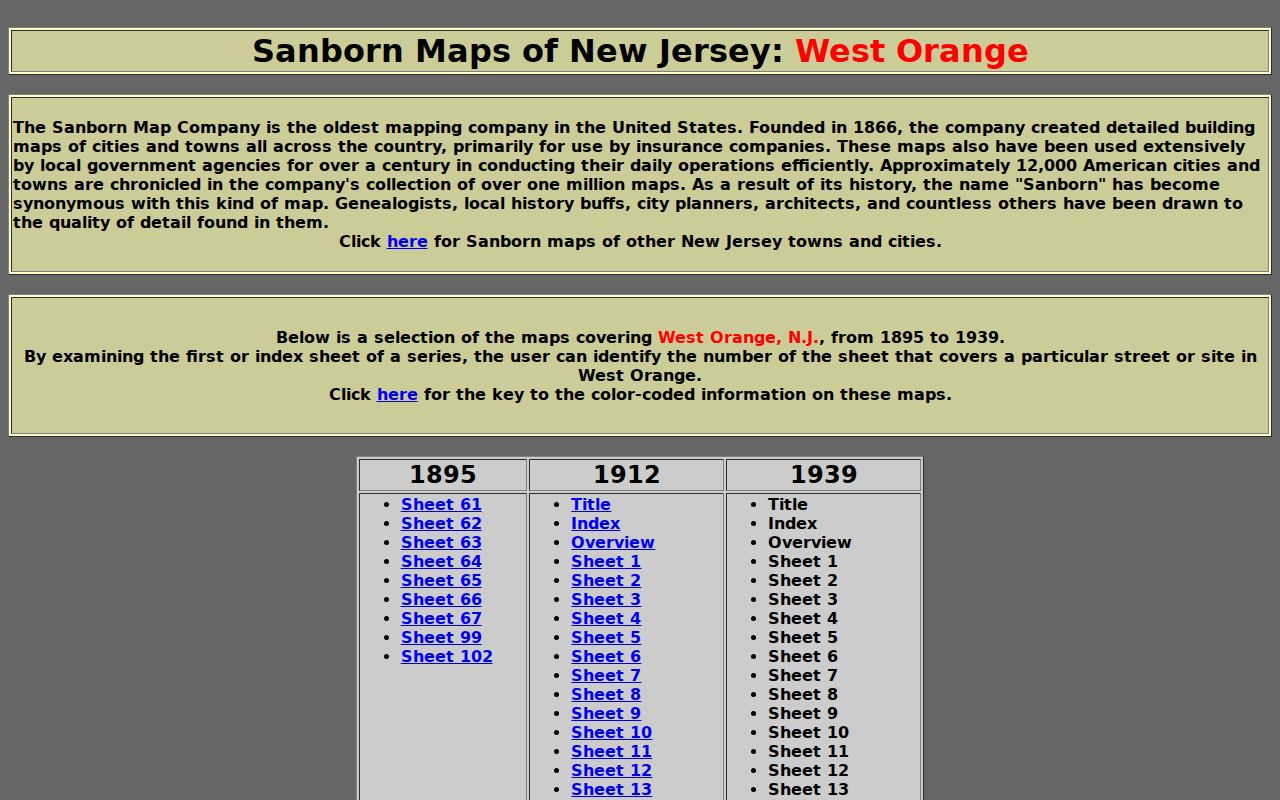
The map guide can help test a building footprint, street layout, or land-use change against a deed date. It cannot establish who lived there. Use it beside a directory, census, or Chronicle result instead of treating a map label as a household record.
The Chronicle microfilm begins in 1942 and reaches the present. A dated address narrows a common-name search and may surface a local notice, property reference, school item, or obituary. Preserve the issue date and page. A notice reports what was published, so it still needs to be weighed against the deed and household records.
West Orange Previous Residents Permit Clues
West Orange Building Department records can date a project when a researcher can identify the address, permit number, certificate, or time period. The Department says it issues construction permits and the related certificates after inspection. Its inspection process asks for a permit number, address, and nature of the inspection. An OPRA request should therefore seek an existing, identified record, not ask staff to reconstruct a whole property history.
The Township's 2025 annual report says the Department processed 2,750 permits connected with about $20.6 million in construction costs. That amount shows why permits can be a meaningful address trail, but it does not create an online search index for individual properties. A permit can date a change. It does not establish the resident or owner at the time.
| Recorded tax certificate | A lien chronology clue. West Orange states that the lien, not the property itself, is sold at its annual tax sale. |
|---|---|
| Deed or recorded transfer | A document in the title chain that must be read for parties, date, and legal description. |
| Permit or certificate | An address-specific construction or inspection lead requested with identifying detail. |
A tax lien is not a sale of the property and is not evidence of who lived there. West Orange says tax-sale certificates are recorded with the Essex County Hall of Records, held for two years before foreclosure may be started, and redeemable before final judgment. Keep those records in a property chronology, not a household conclusion.
West Orange Previous Residents Address Continuity
Do not invent a citywide renumbering rule for West Orange. The research did not locate an official source proving a systemwide street renumbering or a dated street-name change. Preserve each historic spelling and compare the relevant tax-map edition, directory street section, Historic Preservation Commission files, and council ordinance for the individual location. Block and lot provide the steadier bridge when an address format changes.
Local geography can explain why a record looks different without proving an address change. Township history identifies Northfield Avenue and Old Indian Road as original Hackensack trail routes, while downtown developed around the western termini of Newark's Central and Park Avenues. For records before West Orange's 1863 establishment, Fairmount and Orange are also useful place names to test beside the later Township name. Retain the original jurisdiction in the research citation.
West Orange Past Resident Households
Past residents are best confirmed by combining roles rather than merging them. A recorded owner belongs in the deed chain. A directory listing or census may place a household at an address. A Chronicle notice can add a dated local event. Probate, vital, or obituary material may offer an end point for a deceased person or a lead to an heir. Each source should remain labeled for what it actually proves.
For deeper place research, the Historic Preservation Commission archives include 1977–2019 material in Planning Board custody, with appointment or OPRA access, and the 1992 Guter survey is held by Planning and WOPL. The survey is indexed by street address and lot/block. These are building-history aids, not household rosters, but they can connect an address to documented historic context.