
West Orange City Directory Holdings
West Orange Public Library is the key local shelf for this work. Its local-history service identifies the Directory of the Oranges from 1879 through 1956 and the West Orange Chronicle from 1942 to the present. The Library states that the directory run is available on microfilm, online, and in hard copy. Its title is important: it is a regional Oranges collection, not a West-Orange-only sequence. A name hit should therefore be checked for the municipality label and the volume's own scope before it is treated as a West Orange household.
| Collection | Years | Where held | Access |
|---|---|---|---|
| Directory of the Oranges | 1879–1956 | West Orange Public Library | Microfilm, online, and hard-copy access stated by the Library |
| West Orange Chronicle | 1942–present | West Orange Public Library | Microfilm for dated local notices and clippings |
| West-O-Ranger yearbooks | 1934–2017 | WOPL digital yearbooks | Digitized run with identified missing issues |
| Aries yearbooks | 1964–1981 | WOPL digital yearbooks | Digitized run with identified missing issues |
| State census and federal census | NJ 1855–1915; federal through 1950 released | New Jersey State Archives and census routes | Household snapshots, not continuous address rolls |
A city directory establishes a lead, not a final identity finding. The Library's reference staff can help locate the exact year, alphabetical section, and any abbreviation page. Reference service is available at (973) 736-0196, with local-history assistance, catalog help, interlibrary loan, and in-person research described by the Library.
West Orange City Directory Scope
The public collection description does not establish a separate West Orange reverse or criss-cross run. A reverse directory normally works from street and number toward an occupant, but its existence, years, publisher, shelves, and online access must be confirmed with Reference before making an address-to-occupant claim. The safer method is alphabetical: use a dated listing to tie a name to an address, compare nearby issues, then test a conflict with a tax-map block and lot, a recorded instrument, census evidence, or a newspaper notice.
That distinction protects against a common error. A directory can name a household, an owner record can name a recorded party, and neither automatically describes every person at an address. The more recent address-keyed record chain belongs on the West Orange Street Directory page; these volumes are best used as a dated historical layer.
West Orange City Directory Library Shelf
The West Orange Public Library local-history service is the first contact for the stated directory and newspaper runs. Ask for the specific year, whether the title has a street section, and the page that explains local abbreviations. The Library also maintains West Orange-focused books, which can help when a printed entry uses an institution or place name rather than a complete household description.
The Library service view is a useful reminder that the local collection combines directory research with newspaper microfilm and reference help, rather than offering one universal name index.
For a regional online comparison, the digitized 1910 Oranges directory is a verified example. Maplewood Memorial Library's digitization also makes regional volumes from 1888 through 1970 browsable. Those resources supplement WOPL's collection but do not prove that every regional volume has the same coverage or entry format.
Note: The Library's public collection page confirms the main runs, but it does not publish a publisher-by-year or reverse-directory inventory.
Read a West Orange City Directory Entry
Only the digitized 1910 regional sample supplies a verified reading key. Its listings use a name, occupation notation, address, and municipality labels including W.O. for West Orange. The volume defines h as house, wid as widow, bds as boards, and rem as removes. Its street guide records street limits and left- and right-side numbering. Those are features of that 1910 volume, not promises about every issue in the 1879–1956 run.
| Name | Read it exactly, including initials and spacing, before comparing another year. |
|---|---|
| Municipality label | W.O. identifies West Orange in the verified 1910 sample. |
| Occupation | The sample includes occupation notation, which can separate same-name entries. |
| Address | Record the house number and street as printed, then compare it to the street guide. |
| Abbreviations | h, wid, bds, and rem have documented meanings in that volume. |
- Criss-cross directory
- A reverse-style directory arranged from street address toward an occupant. No separate West Orange run is verified by the Library's public page.
- Householder index
- An alphabetical listing that can lead from a name to an address, subject to the volume's scope and conventions.
- Abbreviation key
- The page in a particular volume that defines its shortened labels. Preserve it with the entry transcription.
West Orange City Directory Publishers
The New Jersey State Library catalog gives a regional publisher crosswalk, not a blanket attribution for every West Orange listing. It identifies Isaac P. Baldwin's Baldwin's Orange Directory for 1882–83, Baldwin variants through 1888, F.W. and J.H. Baldwin's regional title for 1889 and 1889–90, F.N. Moffat Co.'s 1890 Essex directory, and J.H. Baldwin volumes from 1890–91 through 1902. It then identifies Price & Lee for a 1916 regional title and for regional West Orange-era volumes in 1934, 1936, 1938, 1940, 1942, 1948, 1950, and 1952.
Titles changed scope across that history. A careful West Orange city directory citation names the actual volume and checks its title page before assigning a publisher or deciding whether the book covers the Township. This volume-by-volume practice is more reliable than treating Baldwin or Price & Lee as a continuous local publisher label.
West Orange City Directory Companions
The WOPL digital-yearbook collection adds a school-era source to a city directory search. West-O-Ranger is listed for 1934–2017, but 1950, 1973, 1982, and 1985 are unavailable. Mountain High School's Aries is listed for 1964–1981, with 1965, 1967, and 1973 unavailable. A missing online issue means the digitized collection has a gap; it does not establish that a person was absent from a school or the Township.
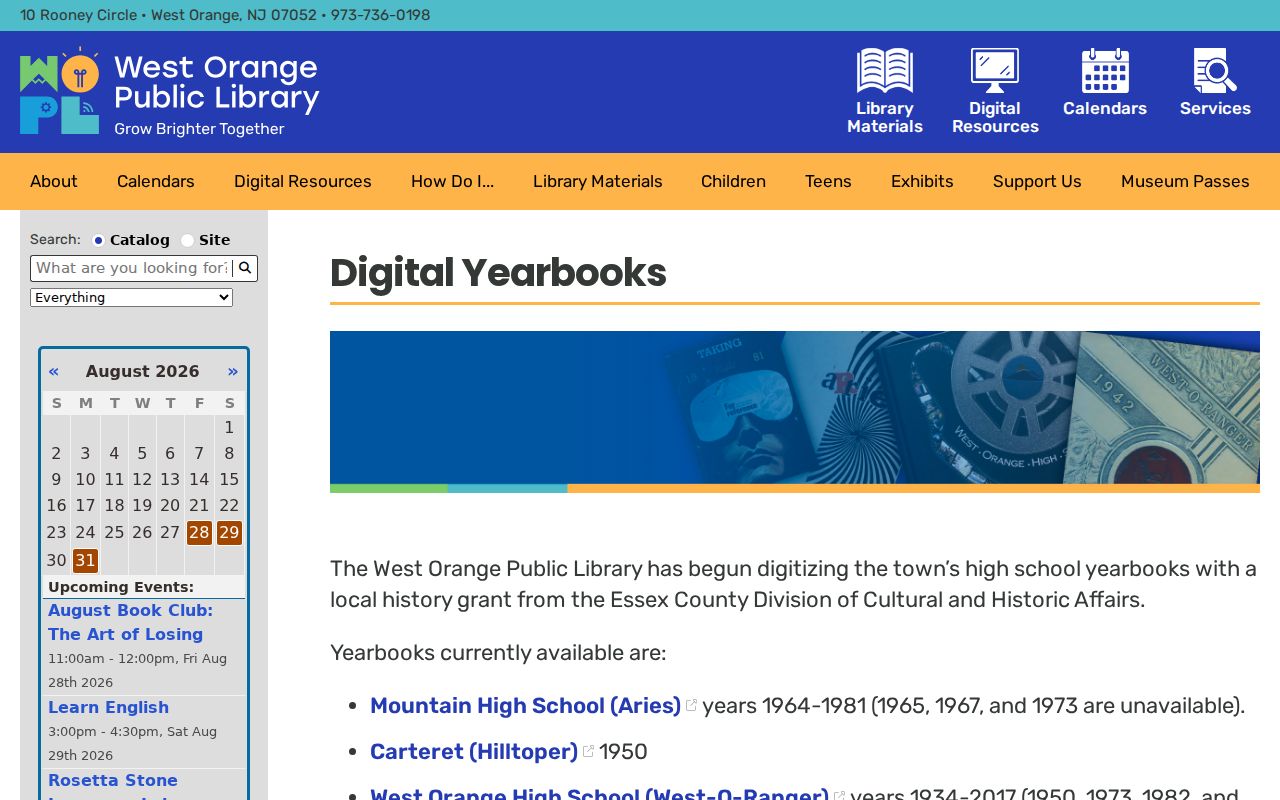
The yearbook portal works best as a dated companion source. Pair a class, activity, or photograph with a directory address, a Chronicle notice, or a census household before drawing a family-history conclusion.
The West Orange Chronicle offers another bridge from 1942 forward. Search a known date range and name variant, then retain the issue date and page. Obituaries, social notices, civic items, and later address references can give context, but a published notice still needs corroboration for legal or household facts.
Trace West Orange City Directory Families
A household trail gains strength when its dates stay visible. Start with the earliest confirmed regional listing, then compare nearby editions for a new street, a removal notation, a widow notation, or an occupation change. Do not infer why a name disappears. A move, a death, an unlisted household, or a changed abbreviation can produce the same apparent gap.
- Choose a named person and transcribe the entry exactly, including the municipality label and the page citation.
- Check nearby volumes for the same spelling, an address change, and any notation the volume itself defines.
- Use the 1910 street guide only as a verified aid for the 1910 sample, not as a rule for every issue.
- Pair a directory year before or after a census with the census household relationships and ages.
- Use a dated Chronicle item, probate material, or a recorded instrument to test a move, death, or property change.
New Jersey State Archives collections add the longer frame: state censuses from 1855 through 1915, with incompleteness noted for 1855, 1865, and 1875, and federal census access through the released 1950 census. Essex naturalizations run from 1792 to 1934 there as well. These series may verify a household's composition or jurisdiction, but they are not a substitute for reading the exact directory issue.
West Orange City Directory Timeline
The surviving sequence changes form over time. The timeline helps decide which evidence can bridge a particular interval instead of assuming one source exists for every year.
- 1879–1956: WOPL's Directory of the Oranges run supplies regional printed listings.
- 1934–2017: West-O-Ranger supplies a digitized school-year layer, subject to its listed gaps.
- 1942–present: Chronicle microfilm provides local notices and context between other records.
- 1855–1915: State censuses supply selected household snapshots, with the early incompleteness noted by the Archives.
- Through 1950 released: Federal census records provide decennial household evidence under the release rule.
West Orange City Directory Archive Paths
When a street or institution matters as much as a name, the Township Historic Preservation Commission finding aid offers another West Orange trail. Its 1977–2019 archives are in Planning Board custody and require appointment or an OPRA route. The holdings include local individuals, institutions, Llewellyn Park material, Edison National Historic Site material, hat factories, a 1937 historical sketch, and Chronicle clippings. The finding aid confirms holdings, not a public name database or copying terms.
The Thomas Edison National Historical Park research archive is a separate place-based option. The Park reports about five million pages of papers and records, selected 1904–29 cash ledgers, and more than 12,000 historic images. Advance appointments are required for archival research, so an archive result should be cited as its own record type rather than folded into a city directory claim.
For a modern confirmation after a historical listing, use an official record that answers the narrower question. A name or address found in an old volume can be checked through a West Orange resident lookup without treating the historical entry as a present-day statement.
Note: Historic Preservation Commission holdings require direct access confirmation before a researcher assumes a folder, copy, or indexed name is available.